

Revenue teams don’t lose deals because they missed a feature – they lose them because follow-up breaks. Notes live in one place, action items in another, and the CRM stays stale until someone remembers to update it. If Avoma isn’t helping your team close that gap, it’s worth looking at alternatives built for client-facing momentum: record without friction, produce clean recaps, surface risks and next steps, and push outcomes straight into the systems that drive pipeline.
This list rounds up the top Avoma alternatives for 2025 that do more than transcribe. Each option is evaluated through a revenue lens – how well it turns meetings into measurable progress across Sales and Customer Success, from discovery to renewal.
Quick Overview of Best Avoma Competitors
- Client-ready recaps + internal-only risks and automated workflows: FuseBase
- Shareable clips for enablement and buyer proof: Grain
- Enterprise CI and forecast impact: Gong
- Budget-friendly capture and CRM logging at scale: Fireflies.ai
- Fast highlights and tidy summaries: Fathom
- Org-wide analytics and engagement insights: Read.ai
- Analytics + templates + automations: MeetGeek
- Simple recording with timestamped highlights: tl;dv
- Product and revenue insights from customer calls: CustomerIQ
- Structured notes and follow-ups with minimal setup: Supernormal
What is Avoma?
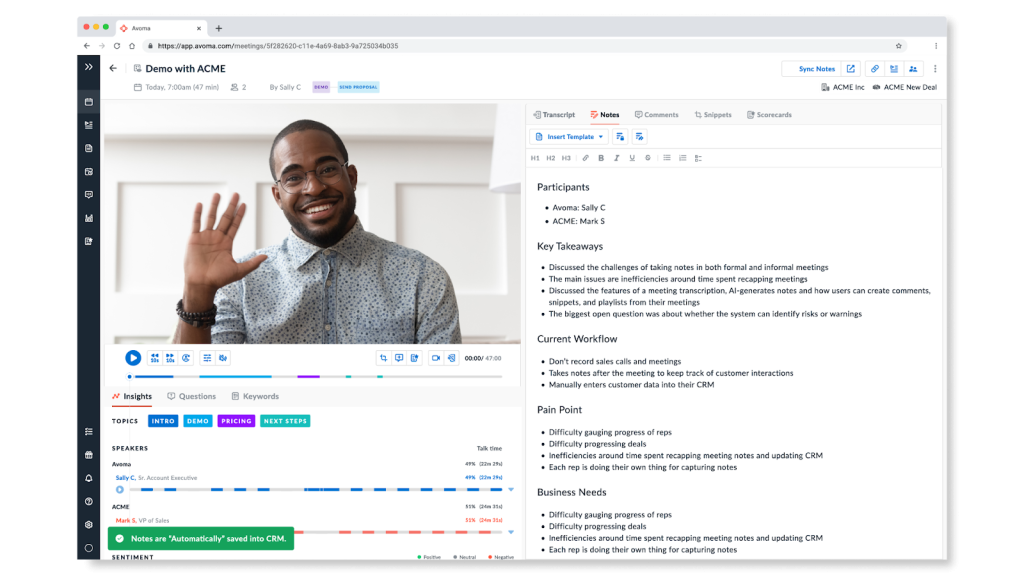
Avoma is an AI meeting assistant that helps teams stay present while it handles the capture. It records your Zoom, Teams, or Meet calls, transcribes in real time, and generates AI notes so follow ups are faster and clearer. For sales, HR, and customer success, it turns conversations into structured insights, action items, and consistent prep using agenda templates that ensure critical questions get covered.
Avoma blends AI note-taking with conversation intelligence. It analyzes talk time, sentiment, and objections, and supports the full meeting lifecycle – pre-call agendas, live transcripts, and post-call summaries in one flow. Managers can review calls for coaching, spot deal insights, and extract action items automatically, making it useful for revenue teams that want both capture and analysis.
However, the visible AI presence can feel intrusive on sensitive calls, and transcription can occasionally mix words or struggle with gaps in messy audio.
Signs You’ve Outgrown Avoma
Avoma can work well early on, but teams that live in client calls often hit a ceiling when the tool stops matching the pace of pipeline and renewals. If several of these sound familiar, it’s usually a signal to evaluate alternatives.
- Follow-ups still depend on “hero reps.” Summaries exist, but next steps aren’t consistently assigned, tracked, and pushed into your CRM/PM tools.
- Your CRM hygiene is slipping. Key fields (next meeting date, stakeholders, objections, risk notes) don’t get updated automatically or get updated inconsistently.
- You need stronger coaching and deal intelligence. Managers want repeatable insights across calls (patterns, risks, talk ratios, objection trends), not just per-meeting notes.
- Client-facing sharing feels clunky. Sharing recaps externally, controlling access, or separating internal vs client notes takes too much effort.
- Scaling creates admin pain. SSO, permissions, retention policies, and governance become “projects,” not settings.
- Your team wants better signal, not more transcripts. You’re drowning in recordings but still missing actionable indicators like renewal risk, buying intent, or stakeholder gaps.
- Revenue workflows outgrew the product. You now need meeting outcomes to trigger plays: tasks, sequences, follow-up emails, and handoffs across Sales to CS.
- Cost rises faster than value. As seats grow, you’re paying more without a proportional lift in pipeline velocity, close rates, or renewal outcomes.
10 Best Avoma Alternatives For Revenue-Driven Teams
1. FuseBase
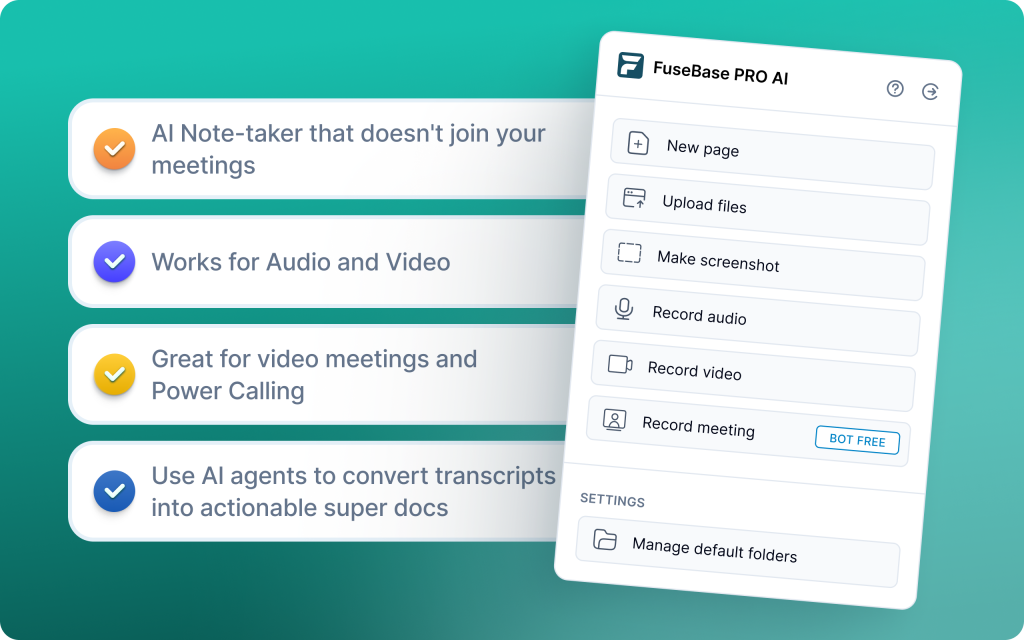
FuseBase is a bot-free AI meeting recorder and workspace that turns every Zoom, Teams, or Meet call into a branded mini-room with recap, files, decisions, and next steps. Instead of sharing a naked transcript link, you share a guided space that looks organized and premium. AI agents watch calls for risks, opportunities, and follow ups, then convert those signals into real actions across your workflows. Dashboards roll up patterns like calls with no next meeting or accounts with rising risk so leaders can intervene fast.
Best for:
- Sales and Customer Success teams running discovery, QBRs, onboarding, and renewals who need client-ready recaps and consistent follow up.
- Teams that want calls to trigger tasks, trackers, and automations in their existing tools without manual cleanup.
- Orgs that care about brand consistency and a professional client experience across every meeting.
Why it stands out:
FuseBase turns every call into a branded mini-room that looks and feels like your system. Clients land in a guided space with recap, decisions, next steps, and all supporting assets under your domain, creating a consistent, premium experience across discovery, QBRs, and onboarding. Under the hood, trackers focus on real revenue signals like no next meeting, missing budget, scope creep vs SOW, renewal risk, and repeated objections, rolling patterns up by account and rep. The full work suite lives around each call – bot-free recording, notes, async video, and shared docs – so the customer story stays in one place. Analytics and AI agents then translate insights into action by auto-creating tasks, populating trackers, and triggering follow ups in your stack, cutting time from call to outcome.
2. Grain
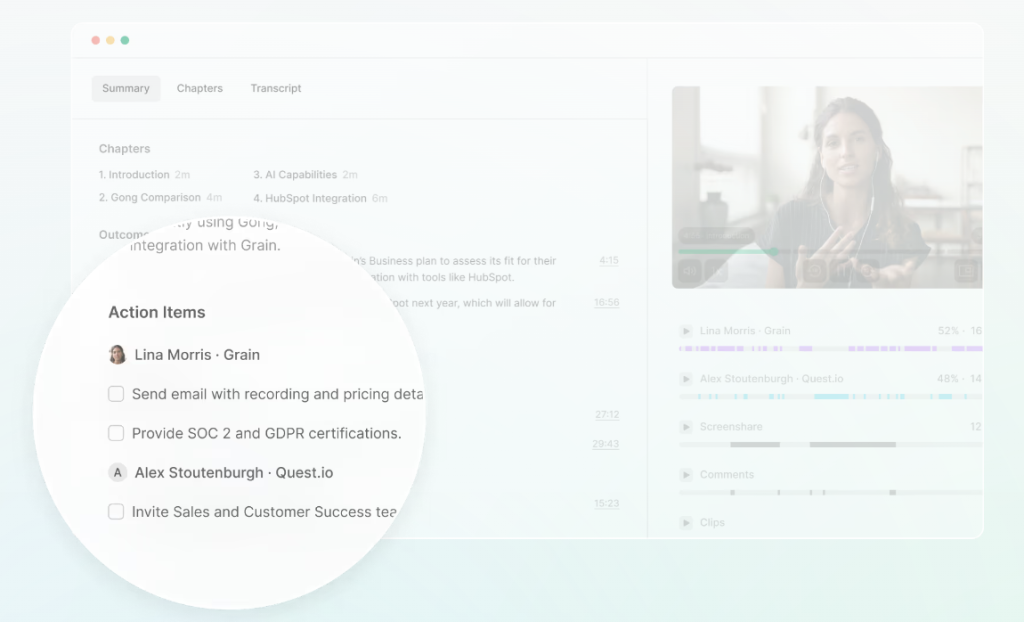
Grain is a meeting capture and clipping tool built for turning long customer calls into short, shareable moments. It records video calls, produces searchable transcripts and recaps, and lets you clip highlights on the spot with its Live Notepad, tagging key moments as they happen. Teams use Grain to build a lightweight knowledge base from real conversations and to align faster across sales, CS, product, and enablement without rewatching full recordings.
Best for:
- Sales and CS teams that need to share proof points with buyers, train new reps with real call snippets, and keep a running library of highlights for proposals, onboarding, and renewals
- Product and content teams capturing voice of customer and quick wins without heavy CI or forecasting.
Why it stands out:
Grain excels at instant, on-call highlight creation and effortless clip sharing, so you ship insights while the context is still fresh. Live Notepad makes it easy to tag moments, spot trends, and track keywords in real time, then auto sync notes to CRM records. Collections of calls and clips create a fast-moving enablement hub that shortens onboarding, improves message consistency, and gets stakeholders aligned without the drag of full-call reviews.
3. Gong
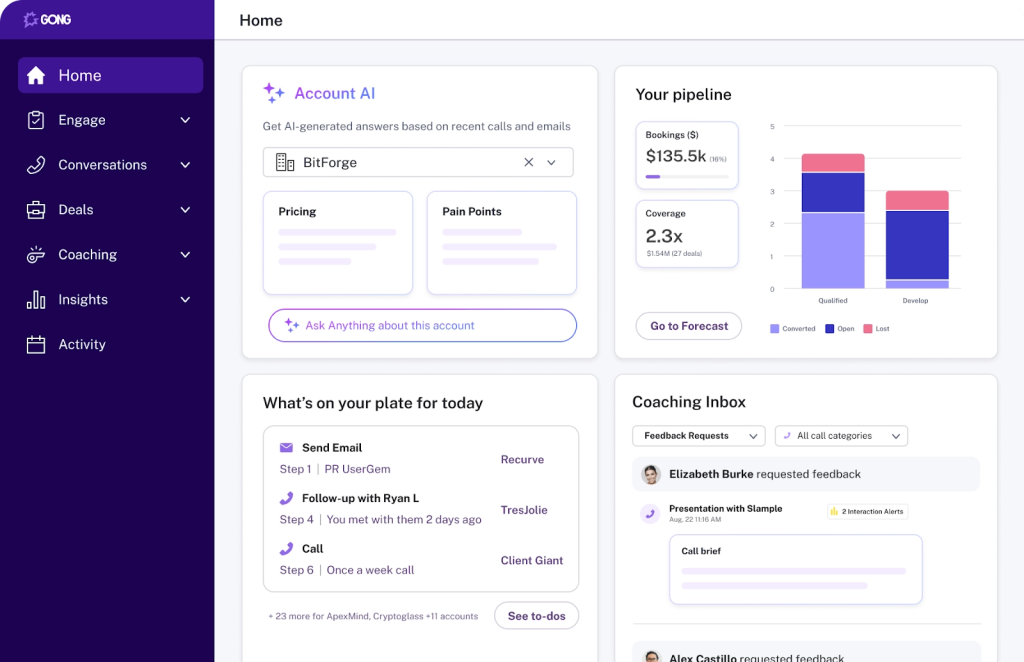
Gong is a revenue intelligence platform built for sales calls that goes far beyond transcription. It analyzes conversations, emails, and meetings to surface sentiment, product interest, deal risk, and next steps, then rolls insights into pipeline views, coaching workflows, and AI-assisted forecasts. With deep CRM integrations and a customizable metric library, leaders get a clear view of what wins, where deals stall, and how to coach reps to higher win rates.
Best for:
- Enterprise sales orgs that need conversation analysis, coaching at scale, and accurate forecast rollups.
- Revenue teams that want deal health signals, risk alerts, and stakeholder coverage visibility tied to CRM stages.
- Leaders who need multilingual coverage, dashboard templates, and AI answers on accounts, deals, and contacts.
Why it stands out:
Gong ties call intelligence directly to revenue outcomes, connecting conversation patterns to deal health and forecast impact. Its CI, deal intelligence, and pipeline management work together, delivering AI summaries, risk flags, and trend lines that make coaching and forecasting measurable and repeatable across large teams.
4. Fireflies.ai
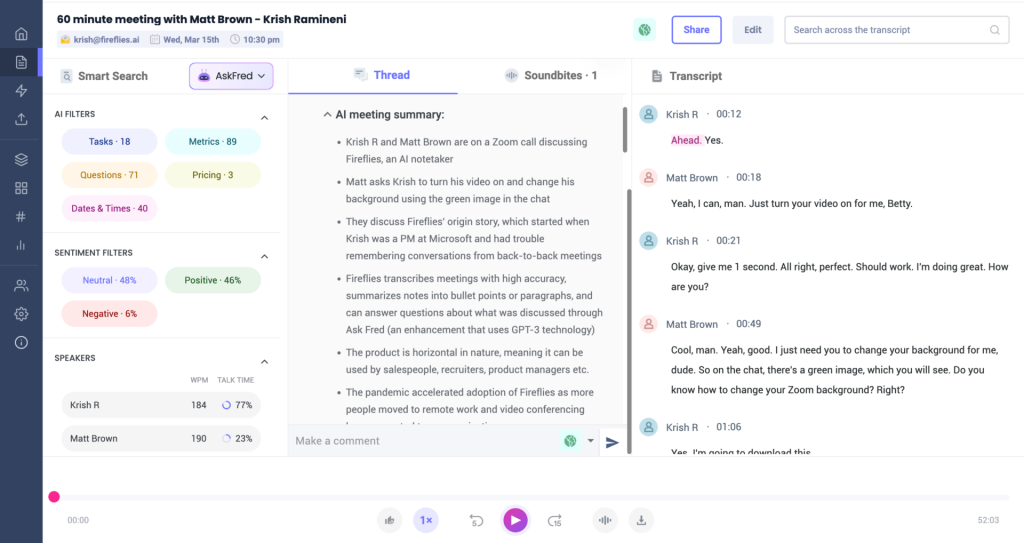
Fireflies.ai is a simple, budget-friendly AI notetaker that captures and transcribes meetings across Zoom, Teams, and Meet, then generates GPT-4 summaries with highlights and action items. It logs key points to CRMs, supports 40+ languages, and offers a searchable call history with tags and filters for fast retrieval. It’s not built for deep coaching or forecasting, but it’s a fast, low-friction entry point for Sales and CS teams that need reliable documentation and minimal setup at scale.
Best for:
- Teams that want affordable, platform-agnostic note capture with quick rollout and no training.
- Sales and CS orgs that need searchable call memory and basic CRM logging without heavy CI.
- Global teams that value multilingual transcription and generous storage on free and business tiers.
Why it stands out:
Fireflies emphasizes speed-to-value and coverage: capture every call, generate concise summaries, and make past conversations easy to find and share. With 40+ language support, generous free storage, and low-cost upgrades, it scales broadly across the org. While it lacks structured coaching and forecasting, its GPT-4 summaries, tagging, and integrations deliver dependable documentation and follow-up context without adding process overhead.
5. Fathom
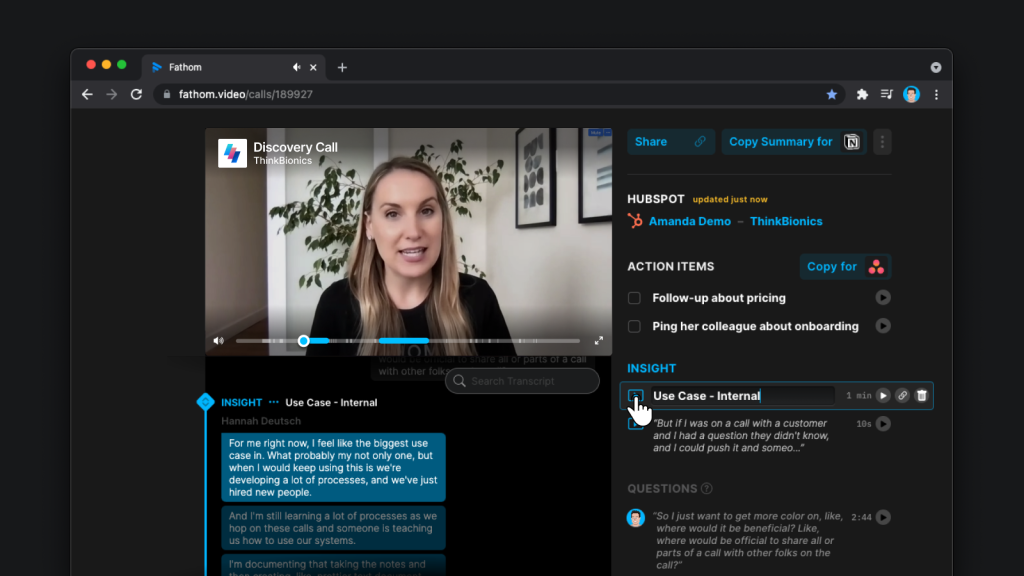
Fathom is a fast, free-first meeting notetaker built for capturing sales insights and delivering instant, clean summaries. It records, transcribes, and highlights Zoom, Meet, and Teams calls, then auto-syncs AI notes, tasks, and timestamps to CRMs like Salesforce, HubSpot, and Close. With templates for sales and CS calls, real-time talk-time feedback, and one-click clip sharing, reps get follow-ups drafted and out the door without juggling tabs or manual logging.
Best for:
- Sales reps and CS teams that want instant AI summaries, CRM sync, and follow-up automation without heavy setup.
- Remote and global teams needing multi-language support and quick clip sharing into Slack and Notion.
- Startups and lean orgs that value unlimited free recordings and simple, reliable workflows.
Why it stands out:
Fathom prioritizes speed-to-action: instant summaries with key points, to-dos, and timestamps, CRM updates pushed automatically, and ready-to-send follow-up emails right after the call. The live experience is built for reps in the moment – real-time talk-time tracking with monologue alerts, one-click highlights, and customizable templates to stay on script.
6. Read.ai
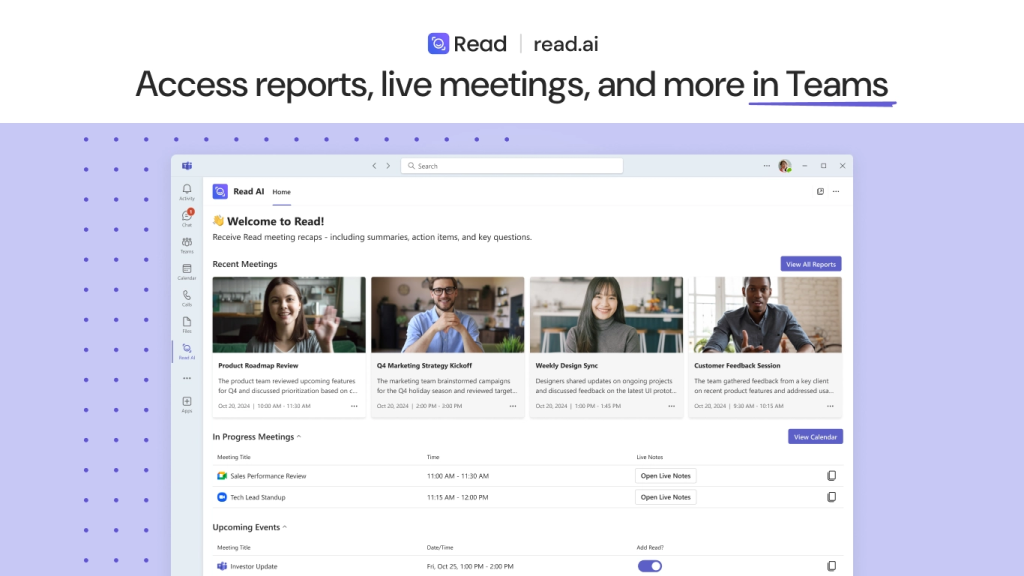
Read.ai is built for enterprise collaboration and analytics. It records and summarizes meetings, then layers cross-team search and a robust insights dashboard so Sales and CS leaders can see engagement, performance, and bottlenecks across the org. With transcription, AI meeting reports, and coaching-style insights, it helps large teams align faster and make informed decisions at scale.
Best for:
- Revenue and CS orgs that need cross-functional visibility and a single source of truth across emails, messages, notes, and meetings.
- Leaders focused on meeting quality, participation, and performance metrics to coach teams and remove bottlenecks.
- Enterprises prioritizing governance, analytics, and repeatable workflows over lightweight note-taking.
Why it stands out:
Read.ai bridges silos with cross-team search and a meeting insights dashboard that turns call data into actionable trends. Instead of isolated transcripts, you get organization-wide signals on engagement and collaboration, plus highlight reels on higher tiers for rapid review. It is engineered for large-scale alignment and data-driven improvement, making it a strong Avoma alternative when you need enterprise-ready analytics and operational clarity.
7. MeetGeek
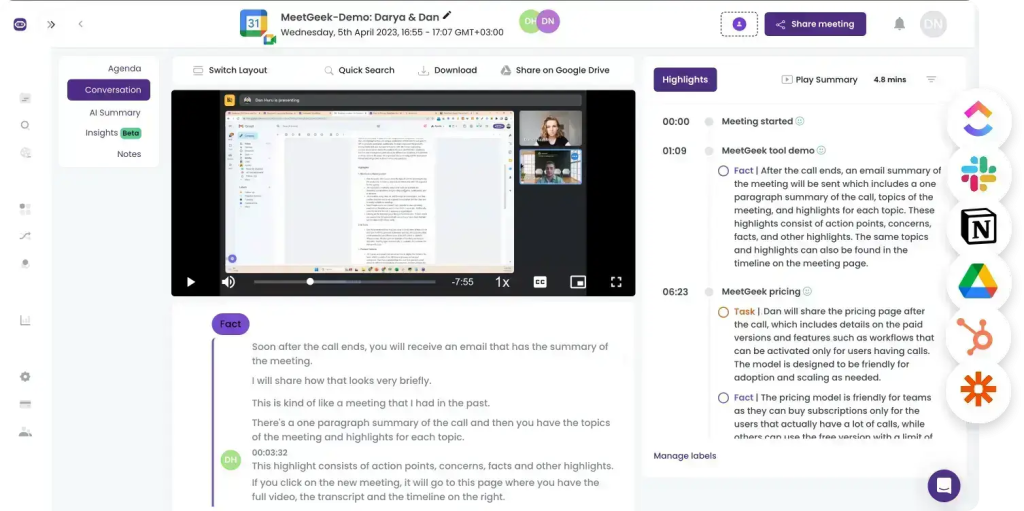
MeetGeek is an AI meeting assistant focused on accuracy, detail, and automation. It records and transcribes your Zoom, Teams, and Meet calls, generates thorough AI summaries with action items, and rolls insights into your stack via 7,000+ integrations. With engagement metrics, sentiment, and 100+ KPIs, it gives Sales and CS leaders a clear read on call quality, coaching opportunities, and where follow ups are slipping, all while keeping a searchable library for team-wide access.
Best for:
- Teams that want advanced analytics, coaching metrics, and a searchable library to reduce meeting inefficiency.
- Orgs that need automated follow ups and deep integrations across Slack, HubSpot, Google Drive, Zapier, and more.
- Global teams that value accurate transcription in 20+ languages and structured templates for discovery, QBRs, and onboarding.
Why it stands out:
MeetGeek blends high-accuracy capture with enterprise-grade analytics and automation. It goes beyond simple summaries by auto-recording and timestamping meetings and piping outcomes into your tools so follow ups fire without manual cleanup. Templates keep calls consistent, folders keep knowledge organized, and the insights dashboard turns conversations into measurable improvements for Sales and Customer Success.
8. tl;dv
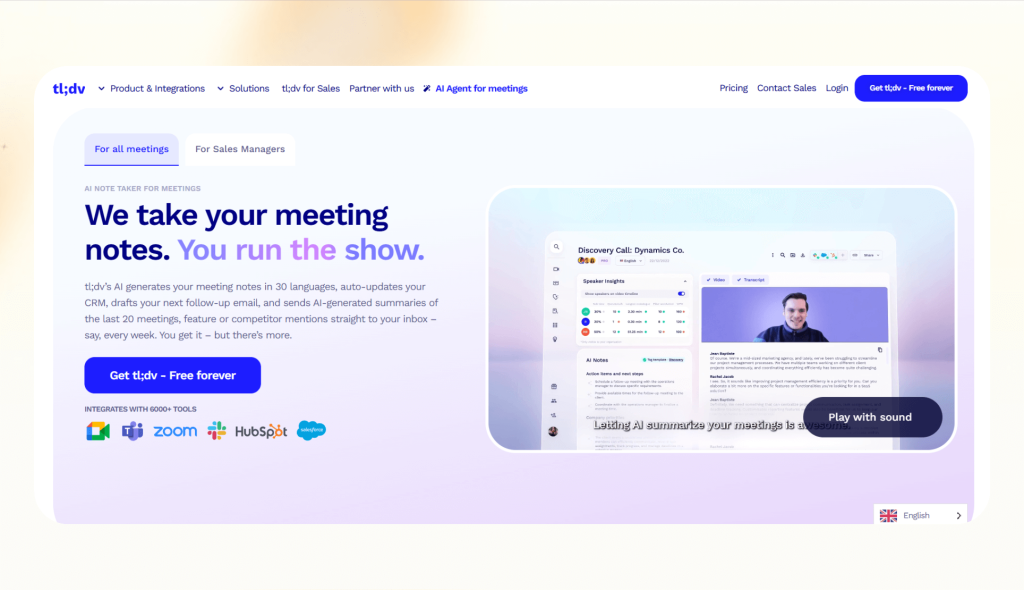
tl;dv is an async-first AI meeting recorder that makes remote collaboration painless. It records and transcribes Zoom, Teams, and Google Meet in real time, then turns calls into searchable assets with highlights, tags, and shareable clips. Beyond capture, it can auto-update your CRM, draft follow-up emails, and deliver coaching insights, while multi-meeting intelligence scans across calls to surface trends and email you the takeaways.
Best for:
- Distributed Sales and CS teams that need fast, searchable recaps, highlight clips, and async-friendly follow ups.
- Global orgs that rely on multilingual transcription and lightweight CRM/documentation integrations.
- Teams that want near-zero setup and a simple, plug-and-play recorder with a collaborative library.
Why it stands out:
tl;dv excels at async alignment: a built-in recording library with keyword search, highlight tagging, and clip sharing means stakeholders can consume only the moments that matter. Multi-meeting intelligence identifies patterns across calls and sends reports to your inbox, while CRM updates and follow-up drafts keep momentum without extra admin.
9. CustomerIQ
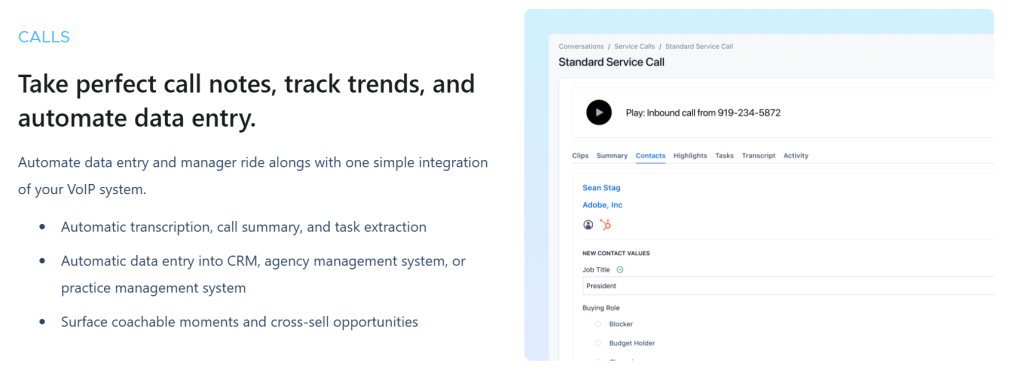
CustomerIQ is an AI platform that centralizes customer signals and automates revenue workflows. It auto-joins meetings to take notes, syncs structured data into Salesforce and HubSpot, organizes rep inboxes, and drafts contextual replies and follow-ups using your company voice. Beyond capture, it quantifies customer needs with cross-channel theme analysis across calls and email, surfaces proactive alerts on at-risk conversations, and delivers coaching insights so leaders can target enablement where it moves pipeline and renewals.
Best for:
- Teams that want CRM automation without manual data entry across contacts, companies, deal stages, and custom fields.
- Orgs that rely on email as much as calls and need AI to triage inboxes, draft replies, and keep follow ups on time.
- Revenue leaders who want cross-channel insights, proactive alerts, and coaching signals to reduce slippage and improve win rates.
Why it stands out:
CustomerIQ connects meetings and email into one intelligence stream, turning conversations into CRM-ready data and action. Its AI email assistant keeps deals warm with contextual drafts that reference specific discussion points, while workspace and account intelligence highlight patterns you would otherwise miss. With HubSpot and Salesforce integrations, theme analysis across channels, and proactive alerts, it shortens time from signal to action and gives Sales and CS a tighter loop on what customers need and what to do next.
10. Supernormal
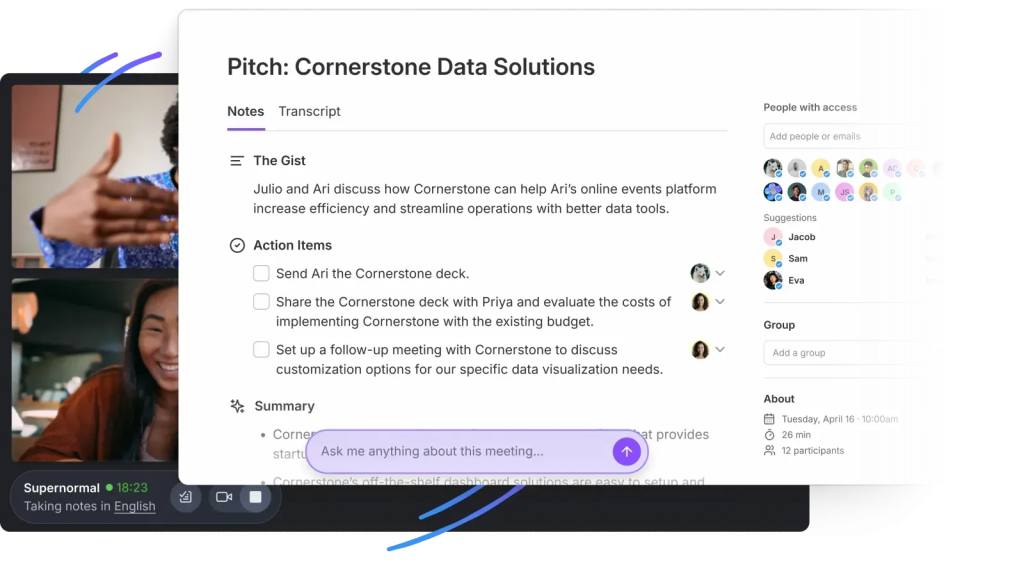
Supernormal is an AI meeting assistant focused on structured documentation and action item flow-through. It captures Zoom and Google Meet calls, generates real-time agendas, recaps, and to-dos, and pushes them directly into tools like Salesforce, Notion, HubSpot, Asana, Trello, Google Docs, and Slack. With customizable templates, a real-time AI assistant, topic-based organization, and 60+ language support, it adapts to your team’s style so every meeting produces consistent, actionable outputs without manual reformatting.
Best for:
- Sales and client-facing teams that need clean, consistent summaries with action items auto-assigned into their workflow tools.
- Project leads who want custom templates per meeting type to keep discovery, standups, and QBRs uniform.
- Global teams requiring multilingual notes, fast recap sharing, and deep integrations across their existing stack.
Why it stands out:
Supernormal excels at turning conversations into structured, on-brand documentation and immediate actions. You design the summary templates, it fills them in live, detects and assigns action items, and syncs everything into your productivity and CRM tools so nothing slips. The real-time AI assistant clarifies points during the call, while topic and group-based organization keep insights retrievable, making it a strong Avoma alternative when you value template-driven consistency and downstream execution over heavyweight CI.
Conclusion
Avoma is a solid choice when you mainly need structured meeting notes and a reliable way to document what happened. But as Sales and Customer Success teams scale, the bottleneck usually isn’t capturing the conversation. It’s turning that conversation into execution: clean follow-ups, clear ownership, and visible progress that carries into the CRM and the next touchpoint.
That’s why FuseBase is the strongest Avoma alternative in this list. It doesn’t just help you remember meetings; it helps you run the work that comes after them. Instead of leaving insights trapped in a recap, FuseBase makes it easier to convert outcomes into client-ready deliverables, internal next steps, and repeatable workflows, so calls consistently translate into pipeline movement, onboarding progress, and renewals that don’t drift.