

Revenue teams don’t need another transcript – they need momentum after every call. If CustomerIQ doesn’t fully match your workflow (coaching, pipeline hygiene, CRM updates, follow-up tasks, and team visibility), it’s worth looking at alternatives designed specifically for sales and customer success execution.
Below are the best CustomerIQ alternatives for revenue teams, picked for conversation intelligence depth, summary accuracy, coaching signals, and the ability to push outcomes into your CRM and daily workflows.
Quick Overview of Top CustomerIQ Alternatives
- FuseBase: Bot-free recorder that turns each call into a branded mini-room with client-ready recaps, internal risks, and automated follow-ups/tasks. Strong on turning conversation into workflow and CRM-updated actions.
- Supernormal: Template-driven summaries that standardize actions, decisions, and owners across Meet/Zoom/Teams. Great for consistent, decision-focused documentation and fast handoffs.
- Bluedot: Chrome extension, bot-free capture with high-accuracy transcription, AI summaries, and CRM sync. Privacy-first with instant follow-ups and searchable highlights.
- Avoma: Cross-functional meeting assistant with agendas-to-transcripts, AI notes, action tracking, and coaching. Strong on collaboration and easy adoption.
- Jamie: On-device, bot-free multilingual transcription and summaries with strong GDPR posture. Ideal for teams prioritizing speed, privacy, and low-friction capture over deep integrations.
- Gong: Revenue intelligence with conversation insights, deal health, coaching, and AI forecasting. Best for analytics-driven execution and predictable pipeline.
- Fathom: Free, beginner-friendly recorder with quick summaries, templates, and CRM sync (HubSpot, Salesforce). Ability to share video clips for context and get real-time talk-time feedback.
- Meetgeek: Organized AI summaries with action items, searchable library, and 100+ KPIs for coaching. Broad integrations (Slack, HubSpot, Zapier) and customizable templates for repeatable workflows.
What is CustomerIQ?
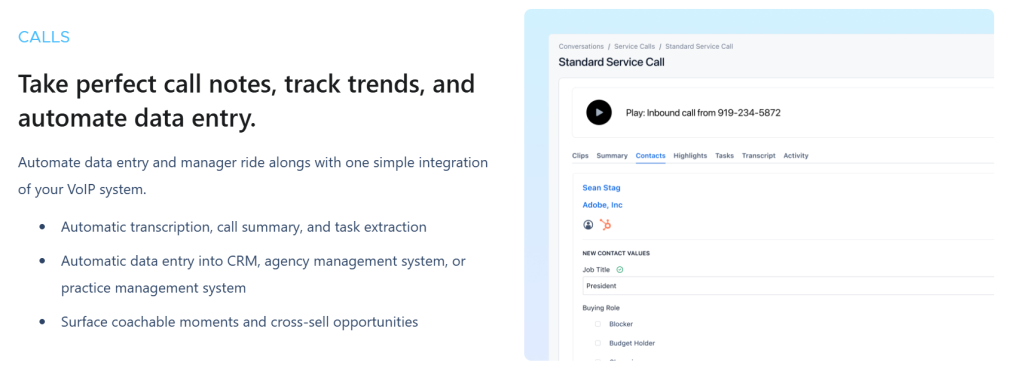
CustomerIQ is a meeting and customer conversation platform designed to help teams document what was said, what matters, and what happens next. This platform positions itself as an AI executive assistant that removes repetitive email and CRM tasks so sales, CS, and leadership can focus on pipeline and retention. It listens to calls, produces meeting recaps immediately, organizes your inbox by priority, and drafts context-aware replies and intelligent follow-ups that reference specific discussion points and align to your company’s voice. Typical outcomes include consistent follow-through without manual writing, better account strategies informed by insight trends, and higher data quality with minimal rep effort. However, it has its drawbacks.
CustomerIQ Drawbacks and Limitations
Bot-style meeting capture can create friction
CustomerIQ’s meeting assistant can join, record, and transcribe meetings (Zoom / Google Meet / Microsoft Teams). That’s convenient—but in some orgs it triggers consent concerns, waiting-room issues, or “no bots” policies that slow adoption. Some participants (or IT policies) don’t like a “notetaker” joining calls.
Platform coverage is strong, but not universal
If your meeting stack is outside Zoom/Meet/Teams, you may need workarounds. CustomerIQ explicitly calls out support for Google Meet, Zoom, and Microsoft Teams, and asks you to contact them if you use something else. If you rely on another platform (or multiple niche tools), that can be a limitation.
Per-seat plans plus usage/credit-based automation can add up
Pricing includes per-seat tiers and additional “workflow/skill credits,” plus add-ons (e.g., shared inbox volume). Teams scaling usage across many reps, calls, and automations can run into caps.
Setup and workflow tuning can take time
You may need configuration and testing to get consistent outputs. CustomerIQ’s docs describe steps to test meeting follow-up behavior (manually joining a meeting, adding a participant email for follow-ups, etc.). That’s normal for automation tools, but it’s a drawback if you want “install and forget” simplicity.
8 Best CustomerIQ Alternatives in 2026
1. FuseBase (Best for revenue-focused client teams)
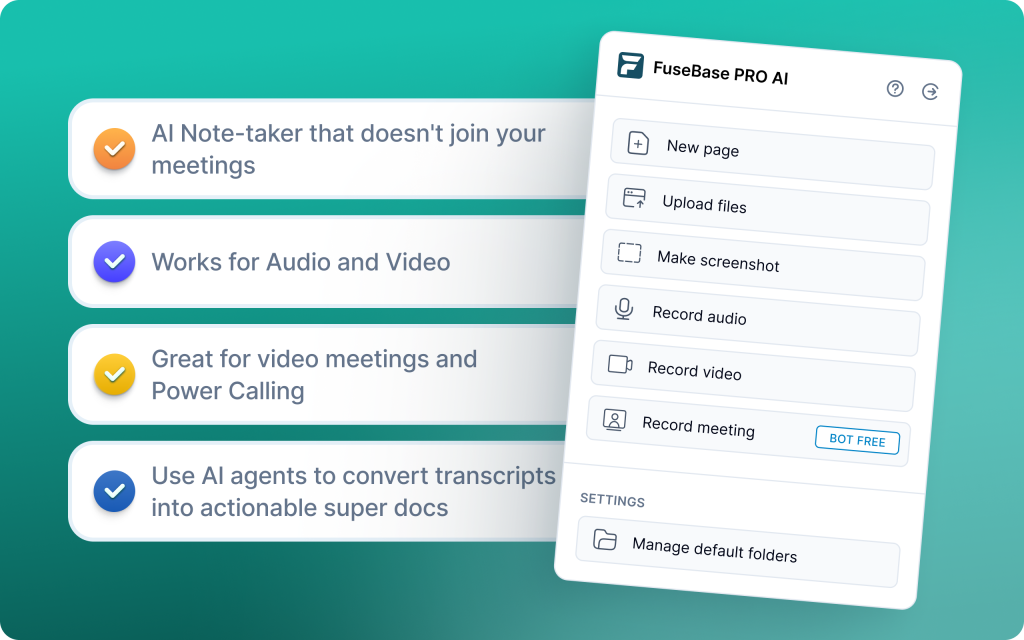
FuseBase is a bot-free AI meeting recorder and workspace that turns every Zoom, Teams, or Meet call into a branded mini-room with recap, decisions, next steps, and supporting assets, not just a smarter transcript link. Each call lands in a white-label “deal/client room” under your domain so revenue teams share client-ready outputs while keeping internal notes, risks, and tasks organized in the same space.
AI agents actively watch calls for signals that move pipeline and retention (no next meeting set, budget gaps, scope creep, renewal risk, repeated objections) then convert those moments into real tasks, trackers, and follow-ups across your tools. Dashboards roll up patterns like “calls with missing next steps” and “accounts with rising risk” so managers can coach and intervene before deals stall. With fast, bot-free capture, personal notes, audio clips, and Loom-style videos embedded alongside files and links, your team spends less time stitching tools together and more time moving revenue forward.
2. Supernormal (Best for consistent, decision-focused documentation)
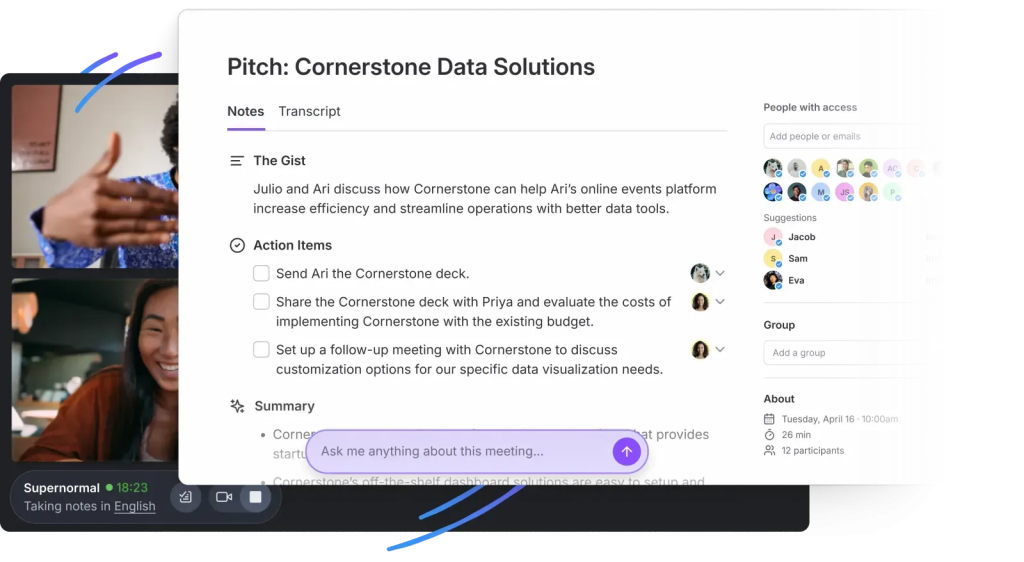
Supernormal is a template-driven, AI-powered meeting assistant that standardizes documentation across Google Meet, Zoom, and Microsoft Teams. It automatically records and transcribes calls, then produces decision-focused summaries that capture actions, owners, and follow-ups in a consistent format so teams can move immediately without cleanup.
A centralized library keeps notes and recordings accessible for quick review and sharing, while automated action item extraction and decision tracking ensure nothing slips. Compared to CustomerIQ’s broader revenue automation, Supernormal prioritizes clarity and consistency in meeting outputs, making it a practical alternative for teams that want reliable, standardized recaps and fast handoffs.
3. Bluedot (Best for bot-free, privacy-conscious transcription and summaries)
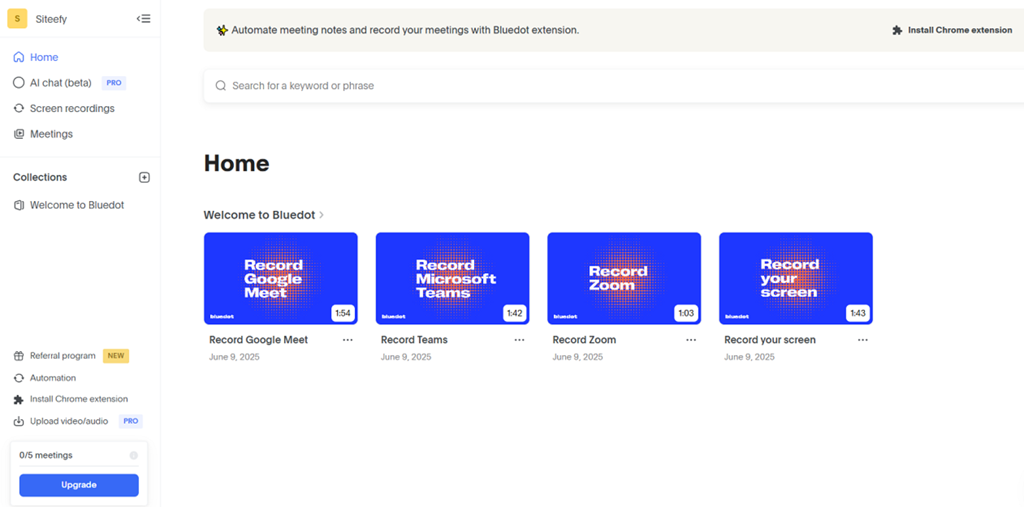
Bluedot is a bot-free, Chrome extension-based meeting assistant that captures high-accuracy transcriptions across any call while preserving participant privacy and reducing compliance friction. It generates AI summaries in seconds, adds detailed conversation analytics with advanced speaker identification, and syncs outcomes to your CRM so follow-ups do not get lost.
Teams can ask AI chat questions about meeting content, auto-draft follow-up emails, edit video by transcript, and share annotated highlights, with real-time transcription in 100+ languages for global coverage. If you want CustomerIQ-like capture and recap without bots or heavy setup, Bluedot is a lightweight, privacy-first alternative for sales, client-facing, and project teams.
4. Avoma (Best for cross-functional collaboration and meeting lifecycle workflows)
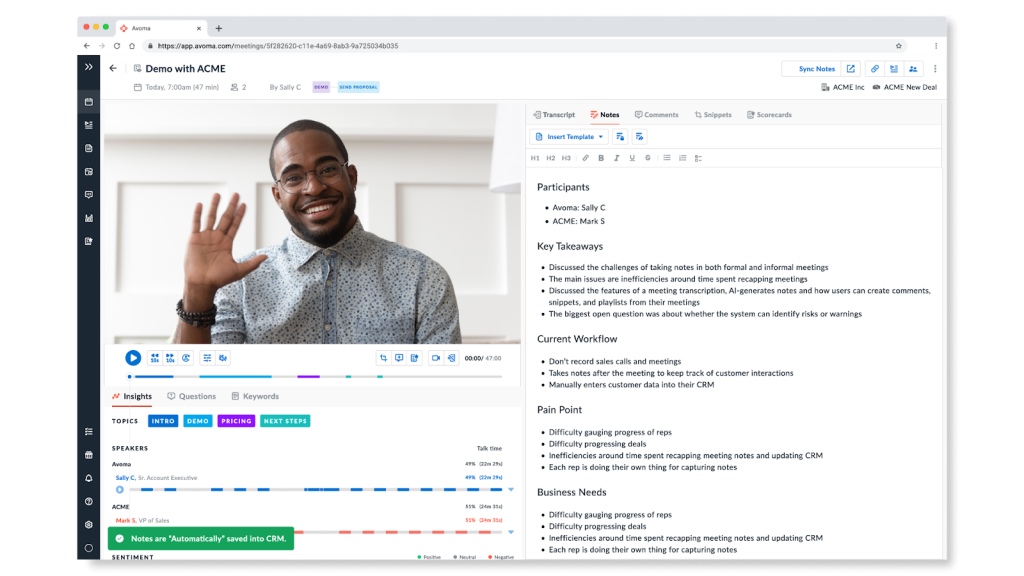
Avoma is an AI meeting assistant built for cross‑functional teams that need clean summaries, action items, and shared visibility across sales, success, and product. It automatically records on Zoom, Google Meet, and Microsoft Teams, synchronizes agendas with transcripts, and generates post‑call notes you can export to Slack, your CRM, or internal docs.
Conversation intelligence covers talk time, objections, and sentiment, while managers can review calls for coaching and trend analytics highlight patterns across internal and external meetings. Lighter than CustomerIQ on forecasting and deep revenue automation, Avoma is a credible alternative when your priority is centralized meeting insights, smooth follow‑ups, and easy adoption with a generous free tier.
5. Jamie (Best for multilingual, on-device capture)
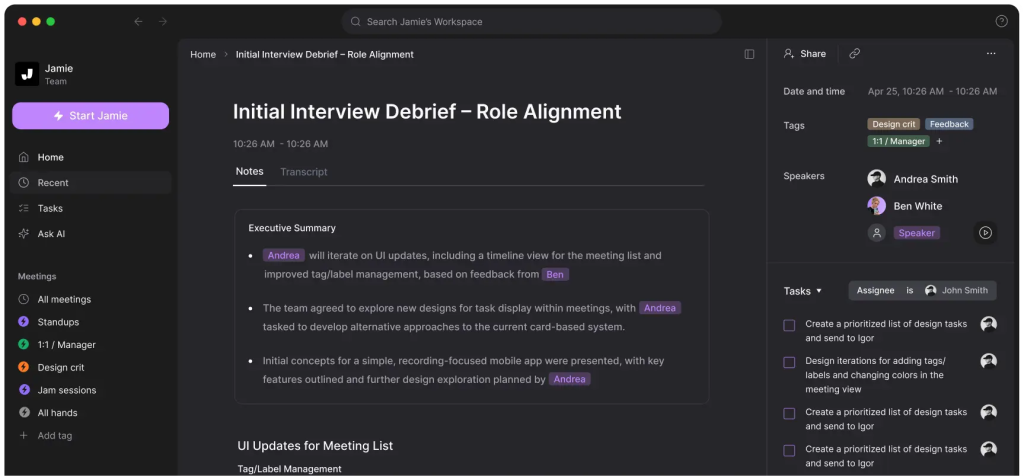
Jamie is a privacy-first, bot-free meeting assistant that runs on your device to transcribe and summarize conversations in multiple languages, online or offline. It delivers fast, accurate notes and clear follow-ups without adding a participant to your calls, minimizing friction and preserving trust.
With a strong GDPR posture and EU hosting, it fits distributed and compliance-conscious teams that need multilingual capture and clean summaries. Compared to CustomerIQ’s broader revenue automation, Jamie offers fewer native CRM or ticketing integrations, but shines when you prioritize speed, simplicity, and privacy over deep workflow depth.
6. Gong (Best for advanced sales analytics and forecasting)
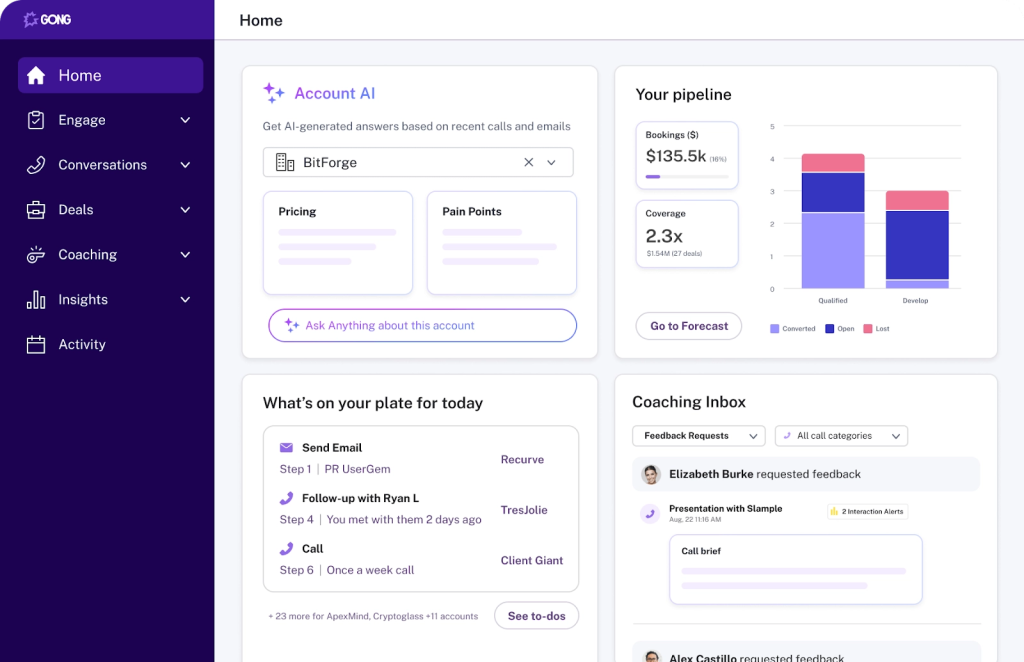
Gong is a revenue intelligence platform that turns calls and emails into deal insights, coaching signals, and forecast inputs, making it a strong CustomerIQ alternative for analytics‑driven teams. It records and analyzes conversations to highlight sentiment, product interest, and risk, then rolls those insights into deal health views and AI‑assisted follow-ups.
Leaders get pipeline visibility and automated forecasting, while reps receive post‑call summaries, coaching feedback, and next‑step guidance synced to Salesforce, Zoom, and Google Meet. If your priority is performance management and predictable revenue, Gong outshines as a data‑rich engine for call notes, insights, and follow-ups.
7. Fathom (Best for fast, free call summaries with CRM sync)
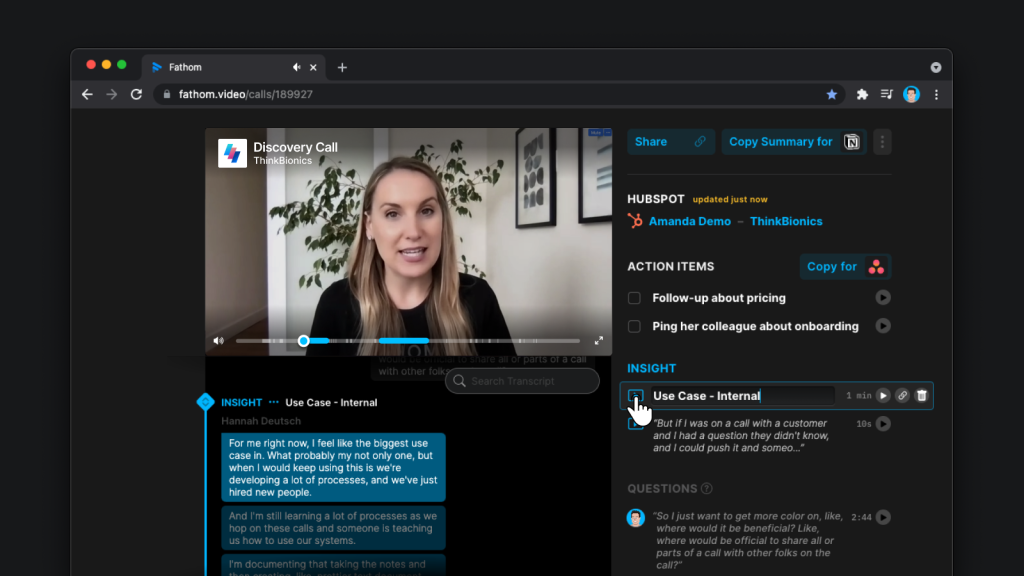
Fathom is a free, easy to adopt meeting assistant that records, transcribes, and summarizes calls so revenue teams can focus on the conversation, not the keyboard. With customizable templates for sales and CS, it standardizes recaps and action items, then syncs summaries and tasks into Salesforce, HubSpot, or Notion to keep pipelines and accounts current.
Reps can share video clips instead of plain text, add context in Slack, and use real time talk time and monologue alerts to sharpen call execution. An AI assistant answers questions about recordings, and support for 20+ languages makes it useful for distributed teams. For revenue teams that want quick setup, clean call summaries, and lightweight CRM updates at a low cost, Fathom is a practical alternative to CustomerIQ.
8. Meetgeek (Best for organized recaps and coaching insights)
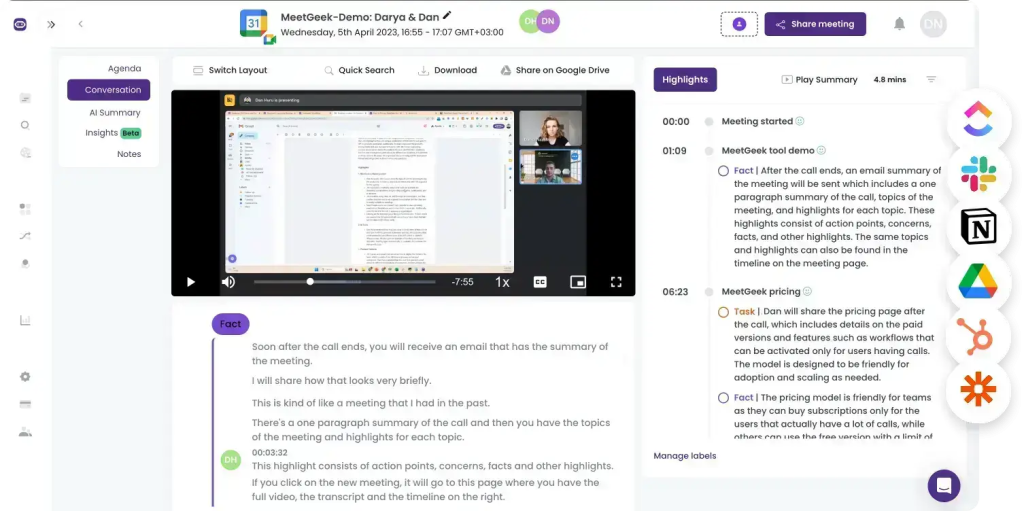
Meetgeek is a well-organized AI meeting assistant for revenue teams that need fast, consistent call summaries, action items, and easy handoffs. It records online or offline meetings, generates AI summaries with key points, and syncs notes to CRM and collaboration apps via thousands of integrations including HubSpot, Slack, Google Drive, and Zapier.
A searchable library and folders make it simple to resurface decisions and highlights, while conversation intelligence delivers engagement metrics, speaker distribution, and 100+ KPIs for coaching. Customizable templates standardize discovery, demos, and QBRs so follow ups are clear and repeatable. Lighter than CustomerIQ on deep revenue automation, Meetgeek shines when you want organized recaps, coaching ready insights, and broad integration coverage without heavy setup.
Summary: Best CustomerIQ Alternatives for Revenue Teams
If your revenue team needs more than transcripts, the best CustomerIQ alternatives are the ones that consistently turn calls into next steps – clean notes, clear action items, and follow-ups that land in your CRM and workflows. Use this shortlist to match the platform to your operating style:
- Choose FuseBase if you want meeting notes and follow-ups delivered inside client-facing workspaces with AI agents and automation – so outcomes are organized, assigned, and visible across the account.
- Choose Gong if you need enterprise-grade revenue intelligence, coaching, and deal visibility.
- Choose Avoma or MeetGeek if you want an all-in-one meeting workflow with strong team collaboration and structured outputs.
- Choose Bluedot if bot-free capture and post-call automation (including admin/CRM workflows) are priorities.
- Choose Supernormal or Fathom if you want lightweight, fast summaries that help reps move quickly after calls.
- Choose Jamie if you want a bot-free, private-by-design assistant focused on decisions and next steps.
The right choice comes down to your goal: coaching and pipeline control, lightweight speed, or end-to-end execution.