

Gong set the bar for conversation intelligence, but in 2026 the market is crowded with strong competitors – often with simpler setup, different pricing models, or features built for specific workflows. Some tools focus on coaching and scorecards, others on pipeline visibility, and others on meeting summaries that reduce admin for sales and CS. Here’s a practical look at the best Gong alternatives and competitors in 2026, so you can find the right fit for your team’s goals and tech stack.
TL;DR – Best Gong Alternatives
- FuseBase: For turning meeting recaps into structured follow-ups and shareable deal workspaces.
- Avoma: For revenue-team meeting workflows with solid analysis and collaboration.
- Read.ai: For org-wide visibility and coaching signals across departments.
- tl;dv: For highlight-driven deal reviews and sharing key moments fast.
- MeetGeek: For organized summaries, meeting history, and team-friendly recaps.
- Otter.ai: For straightforward transcripts and summaries with easy adoption.
- Grain: For clip-first coaching and building shareable call libraries.
What is Gong.io?
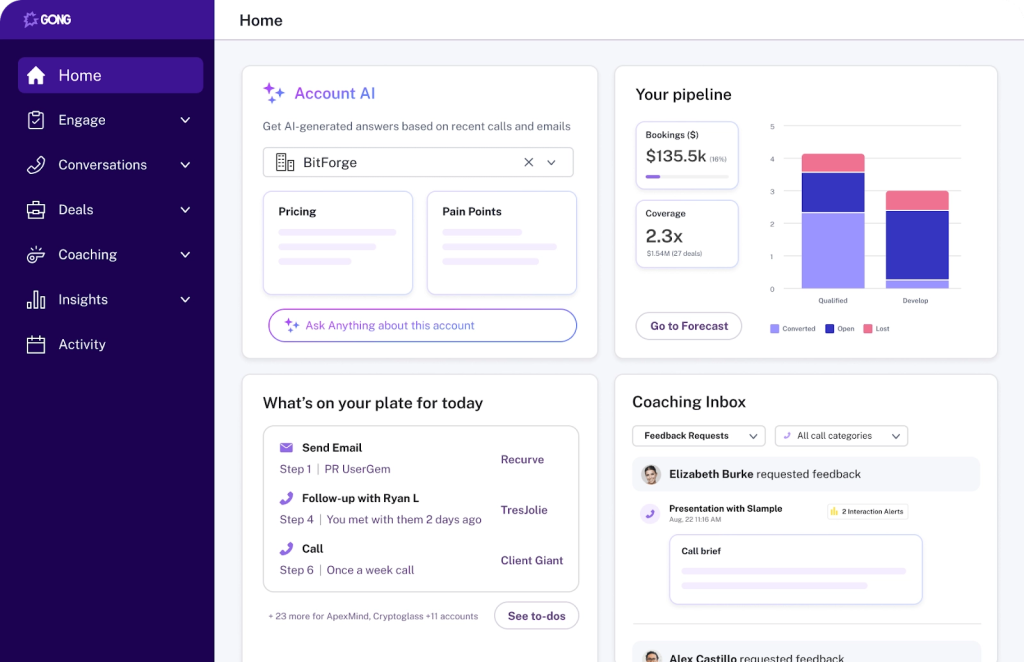
Gong.io is a revenue intelligence platform built for sales calls that turns customer interactions into actionable insight. It goes far beyond transcription by analyzing conversations for sentiment, product interest, deal risk, and next steps, then rolling those signals into forecasts and pipeline reviews. The outcome is sharper coaching, cleaner deal execution, and steadier revenue growth. It’s best for sales teams that need detailed analytics and AI-driven guidance. Sales managers and leaders use Gong to inspect team performance across reps and stages, with conversation intelligence to capture and analyze calls, deal intelligence to monitor health and flag risk, and pipeline management to visualize coverage while automating sales predictions. AI-generated summaries speed follow-ups, and integrations with Salesforce, Zoom, and Google Meet keep data in sync.
Gong.io Pros and Cons
Gong remains one of the most recognized platforms in revenue intelligence, especially for teams that want structured call reviews and consistent coaching. But it’s not always the best fit depending on your team size, budget, and how deeply you want conversation insights to connect to forecasting and workflows.
Pros:
- Best-in-class conversation intelligence: Strong call recording, transcription, and analysis with a deep searchable library for reps and managers.
- Coaching at scale: Trackers, scorecards, and call libraries make it easier to standardize coaching and onboarding across teams.
- Deal visibility for leadership: Helpful for deal reviews, identifying risk signals, and improving consistency in sales execution.
- Enterprise-ready controls: Mature governance, permissions, and security options for larger orgs and complex teams.
- Ecosystem and integrations: Commonly integrates with major CRMs and sales tools, making it easier to fit into established stacks.
- Cross-meeting insights: patterns by segment, rep, product, and stage to guide enablement and roadmap conversations
Cons
- Pricing can be high: Costs tend to rise quickly as you scale users, teams, and feature needs.
- Limited flexibility for niche workflows: customization and special edge cases can feel constrained
- Implementation effort: Getting full value often requires configuration, ongoing tuning, and RevOps/admin support.
- Overkill for lighter use cases: If your team mainly needs fast meeting notes and follow-ups, Gong may feel too heavy.
- Adoption-dependent results: Forecast and deal signals rely on consistent usage and good CRM hygiene – uneven adoption weakens outcomes.
- Client-facing friction: Recording policies, consent workflows, or bot-based capture can create resistance in some external meetings.
Top 7 Gong Alternatives in 2026
Choosing a Gong alternative is about matching the platform to how your team actually runs coaching, meeting follow-ups, and deal reviews. Some tools lean into manager-led coaching and call libraries, others focus on fast summaries and shareable highlights, and a few connect meeting insights directly to pipeline workflows. Here are the top 7 Gong alternatives in 2026, selected for teams that want better execution after every conversation.
1. FuseBase (best for client-facing teams that need branded recaps)
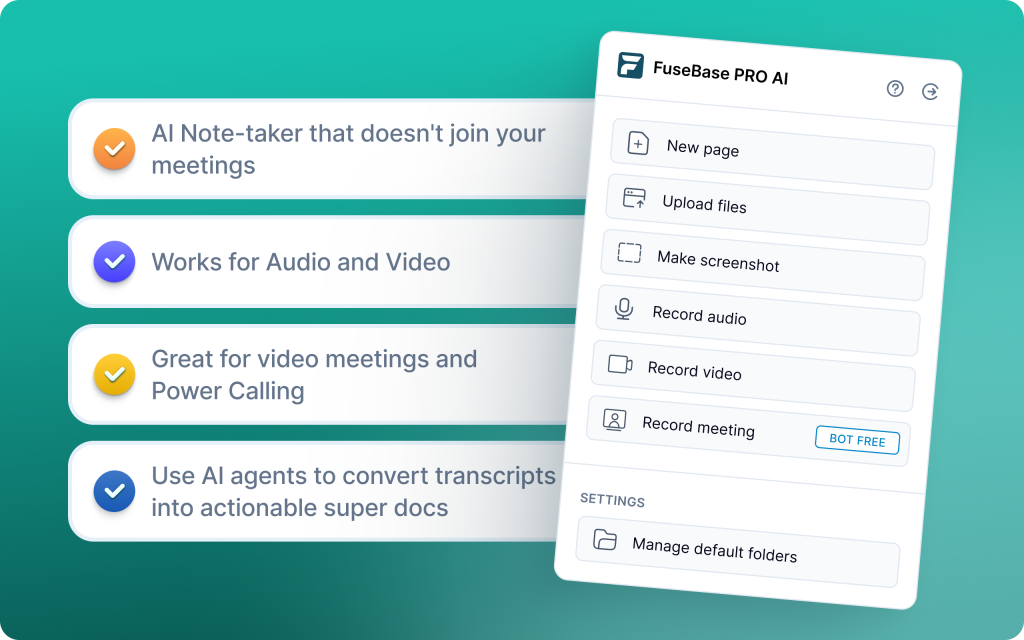
FuseBase is a bot-free AI meeting recorder and client workspace that turns every Zoom, Teams, or Meet call into a branded mini-room with recap, decisions, next steps, and all supporting files in one place. Instead of sharing a naked transcript link, you share a guided, white-label space under your domain. Behind the scenes, AI agents watch calls for risk, opportunities, and follow-ups, then create tasks, populate trackers, and trigger workflows so coaching, deal reviews, and post-call execution happen fast.
Pros:
- Mini-rooms per meeting on your domain for client-ready recaps and internal-only notes
- Consistent white-label experience across discovery, QBRs, onboarding, and renewals
- Trackers for real business signals like no next meeting, budget gaps, scope creep, renewal risk, and repeated objections
- AI agents that auto-create tasks, populate trackers, and trigger follow-ups in your existing tools
- Bot-free recording plus personal notes, audio notes, Loom-style videos, and shared docs in the same room
- Deal and account rollups that surface patterns by rep, account, stage, or product line
- Dashboards highlighting calls with no next steps and accounts with rising risk signals to reduce churn and missed follow-ups
Cons:
- More powerful than a basic notetaker, so teams should align on room templates and governance upfront
- Requires light setup to connect CRM and project tools for full automation value
2. Avoma (best for meeting lifecycle from agenda to recap)
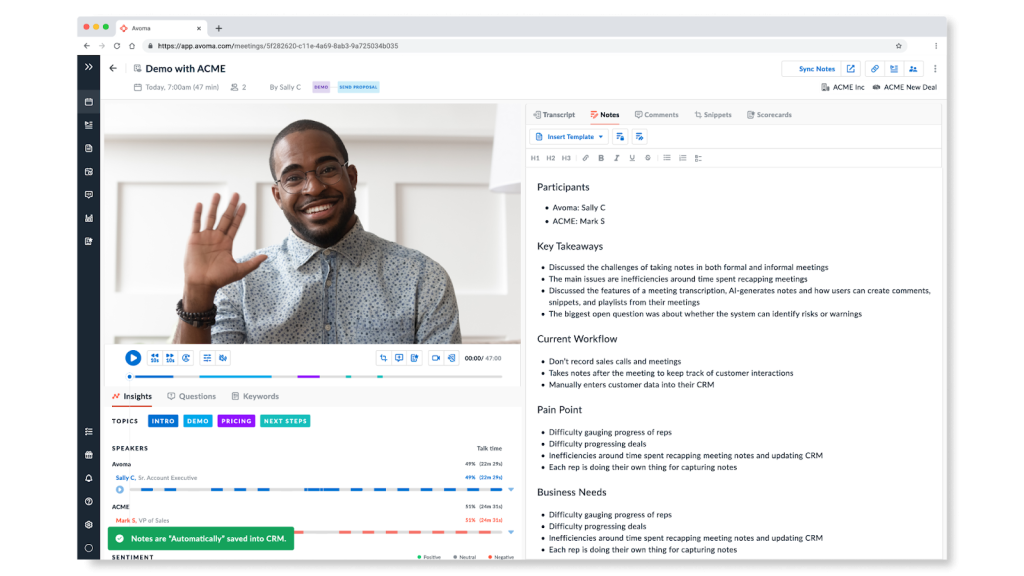
Avoma automates note-taking, real-time transcription, and post-call analysis so your team can stay present in the conversation. It connects agendas to what actually happened in the meeting, generates AI notes and next steps, and layers conversation intelligence (talk time, objections, sentiment) to surface coaching moments and deal insights. From pre-meeting prep to post-call follow-up, Avoma streamlines the full meeting lifecycle for revenue teams.
Pros:
- Real-time transcription with AI summaries and clear next steps
- Agenda templates mapped to the transcript for tighter discovery and QBRs
- Conversation intelligence for talk-time, objections, and sentiment analysis
- Meeting lifecycle coverage: pre-meeting agendas, live notes, post-call recaps
- Trend analytics across internal/external calls to spot patterns and risks
- Cross-functional collaboration via comments, highlights, and shareable clips
Cons:
- Intrusive “bot” presence in meetings for some participants
- Occasional transcription gaps or word mix-ups under noisy conditions
3. Read.ai (best for enterprise meeting analytics at scale)
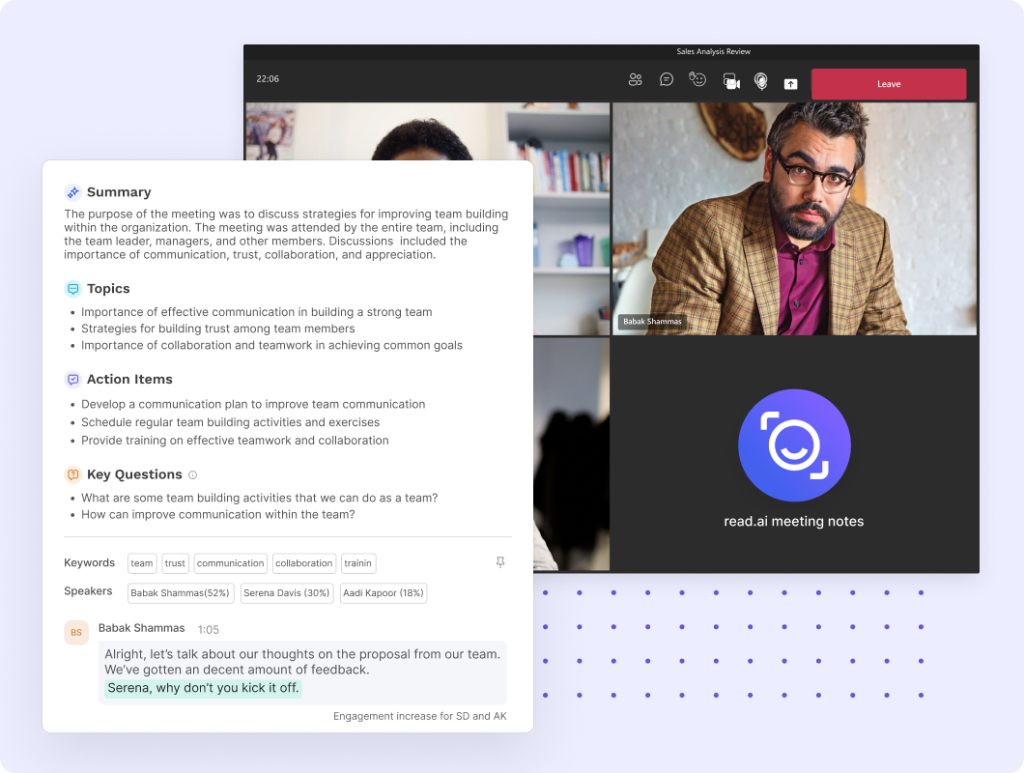
Read.ai is an enterprise-focused meeting analytics platform that records Zoom, Teams, and Google Meet, then layers real-time transcripts, engagement, and sentiment into dashboards leaders can act on. Beyond note-taking, it unifies context across meetings, Slack/Teams, and email, so revenue, CS, and product can search the same source of truth, inspect bottlenecks, and coach with consistent signals. Think Gong-style insights with a heavier emphasis on cross-team discovery and decision support.
Pros:
- Meeting insights dashboard with engagement, sentiment, trends, and bottleneck analysis
- Real-time transcripts and summaries during calls to speed follow-ups
- Speaker Coach for talk-time and delivery feedback to uplevel rep performance
- Playback and highlight reels for quick review without rewatching full meetings
- Enterprise integrations and governance for large, cross-functional rollouts
- Conversation tracking across apps to align sales, CS, and product on one dataset
Cons:
- Bot/calendar behavior can feel intrusive and hard to fully disable for some users
- Free plan is too limited for meaningful enterprise evaluation
4. tl;dv (best for async recaps and clip sharing)
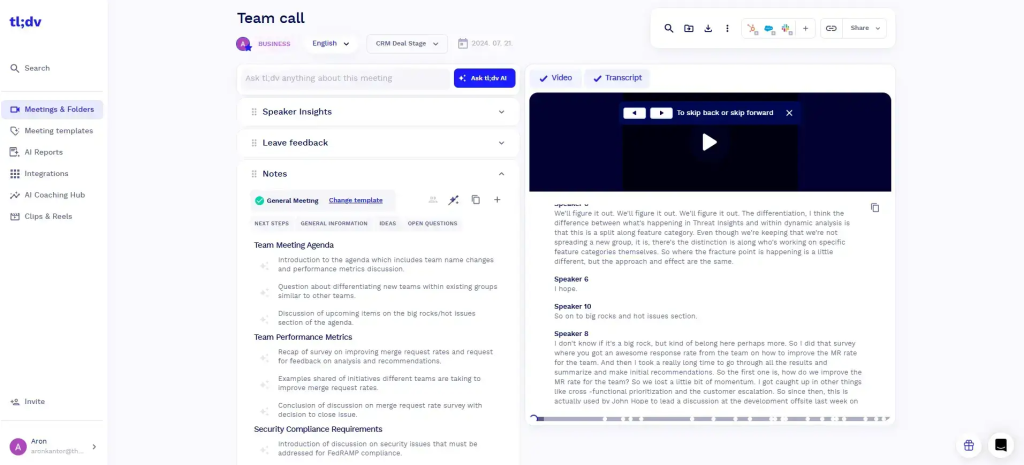
tl;dv is an AI-powered meeting recorder for Google Meet, Microsoft Teams, and Zoom that focuses on fast capture, precise real-time transcription, and easy sharing. The bot joins calls, generates multilingual transcripts and post-call summaries, and lets teams tag highlights and share clips so distributed stakeholders can align asynchronously. It’s not built for deep sales analytics or forecasting, but it excels at creating clear, accessible records of what happened in meetings.
Pros:
- Real-time recording and transcription across Meet, Teams, and Zoom
- Multilingual support (30+ languages) for global teams
- Timestamped highlights and shareable clips for quick context
- AI-generated summaries post-call to align on next steps
- Async-friendly workflows that help remote teams stay in sync
- Simple setup with integrations into common docs and CRMs
Cons:
- Limited conversation intelligence and coaching depth vs Gong
- CRM logging and sales-specific workflows are light
5. MeetGeek (best for context-rich summaries and next steps)
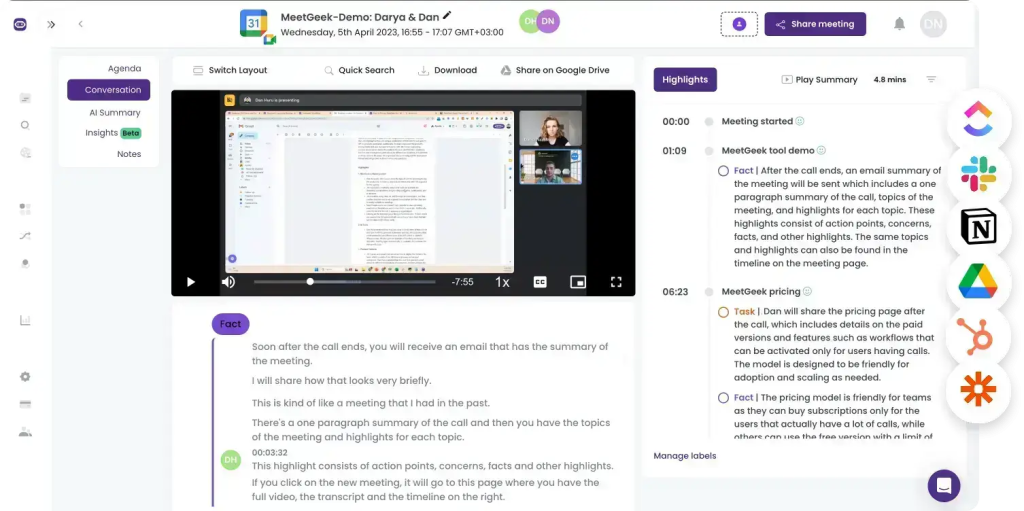
MeetGeek is an organized AI meeting assistant that records Zoom/Teams/Meet, transcribes with clarity, and turns conversations into context-rich summaries, decisions, and next steps. It pins action items to exact transcript moments, streams updates into Slack and CRMs, and rolls up analytics so managers can see patterns, coaching gaps, and deal risks without rewatching full calls. It’s lighter than Gong on forecasting, but strong on coaching cues, meeting insights, and smooth follow-through.
Pros:
- Clean recording and accurate, scannable transcripts with timestamps
- Summaries that highlight what matters, not just a transcript rehash
- Action items and key decisions pinned to transcript moments for context
- Native handoffs to Slack, HubSpot, Notion, Google Drive, and CRMs
- Trend analytics for engagement, topics, and meeting productivity
- Templates, folders, and a searchable library for repeatable workflows
Cons:
- Free tier limits transcription features and depth
- AI summaries can miss nuance in complex, context-heavy calls
6. Otter.ai (best for shared, searchable meeting text)
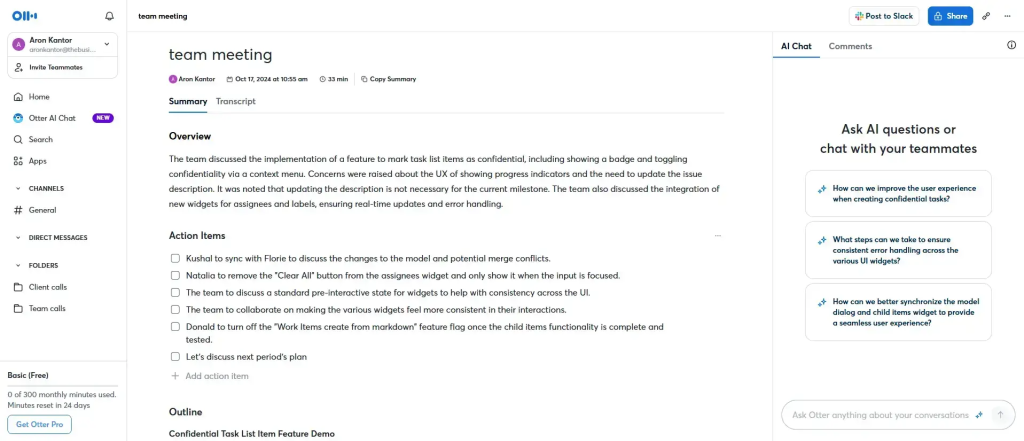
Otter is a transcription-first meeting assistant that turns conversations into searchable, shareable text in real time. It supports meetings and interviews, offers live captions for accessibility, and lets teams annotate and discuss content as the call unfolds. With Zoom-native workflows, multi-user workspaces, and automated summaries, Otter delivers fast capture and lightweight coaching review without the overhead of full-blown conversation intelligence or forecasting.
Pros:
- Real-time transcription and live captions for instant clarity
- Automated summaries and highlights to speed post-call follow-ups
- Multi-user collaboration with shared workspaces, comments, and highlights
- Speaker identification to attribute who said what
- Zoom integration for auto-join and automatic transcriptions
- Mobile apps for on-the-go capture and review
Cons:
- Can confuse speakers in large, multi-participant meetings
- Limited language support compared to CI tools focused on global teams
7. Grain (best for quick playlists to onboard and train)
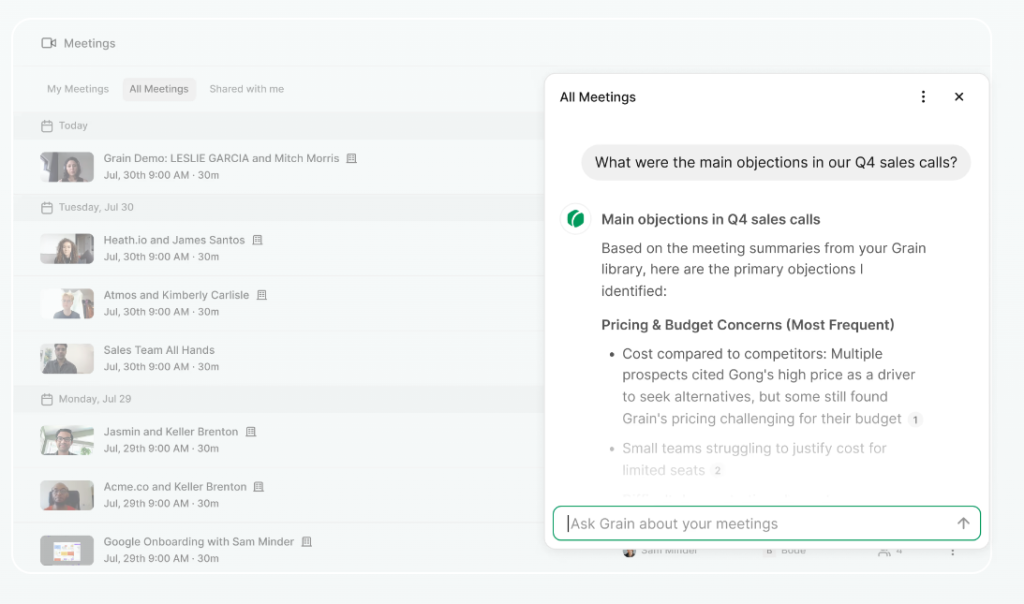
Grain is a video-first meeting recorder that auto-joins Zoom/Teams/Meet, transcribes calls, and turns the most important moments into shareable clips and playlists. Instead of rewatching full recordings, managers review highlights, track talk-listen ratios, and coach with real examples. Grain’s CRM sync logs AI notes to HubSpot and Salesforce so follow-ups and proposals move faster, while libraries and “People” filters make deal reviews and onboarding efficient.
Pros:
- Auto-records and transcribes calls with clear AI summaries
- One-click clips, highlights, and playlists to share coachable moments
- Trend and keyword tracking with real-time alerts during meetings
- Talk-listen ratio, speaker timelines, and filters by rep/account for faster reviews
- CRM sync to Salesforce and HubSpot with automatic call notes on deals and contacts
- Simple rollout with reliable capture and a searchable video library
Cons:
- Integrations and API are lighter outside core CRMs and can feel limiting
- External sharing can create permission friction for recipients
Choosing the Best Gong Alternative in 2026
Start by defining what “success” looks like after a call. If the goal is to consistently move deals forward – with a clear place to capture decisions, align stakeholders, and turn conversation into execution – FuseBase is the most complete choice here. It’s a strong fit for client-facing teams that need clean, shareable recaps and a reliable way to move work forward, not just analyze conversations.
If your team wants a dedicated meeting platform built around sales routines, Avoma is a strong pick for organizing notes, action items, and coaching-style workflows. When you care most about meeting insights beyond the transcript – like engagement signals and meeting-level analytics –Read.ai becomes relevant. For teams that run deal reviews by sharing “the moment that mattered,” tl;dv and Grain stand out: tl;dv is geared toward fast review and highlight sharing across the team, while Grain is ideal when you build coaching libraries from clips. MeetGeek is a practical option if you want dependable summaries and a clean meeting archive without heavy process change. And if you simply need accurate transcripts and quick summaries with minimal setup, Otter.ai is often the easiest baseline to roll out. The best pick is the one that aligns with how you coach, review, and follow up week to week.